Most people trust GPS like they trust electricity. It just works. You open a map, you get a dot, and you move on. Because of that, many property owners assume modern land surveying runs on perfect satellite accuracy every day of the year. However, that is not always true.
During periods of high solar activity, GPS signals can weaken, bend, or drift. As a result, measurements can lose precision if crews do not apply the right field checks. This does not mean land surveying becomes unreliable. Instead, it shows why professional survey methods matter more than ever when conditions change.
Why Modern Land Surveying Uses GPS So Heavily
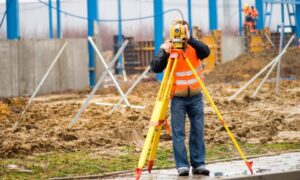
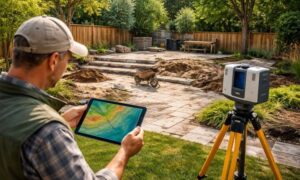
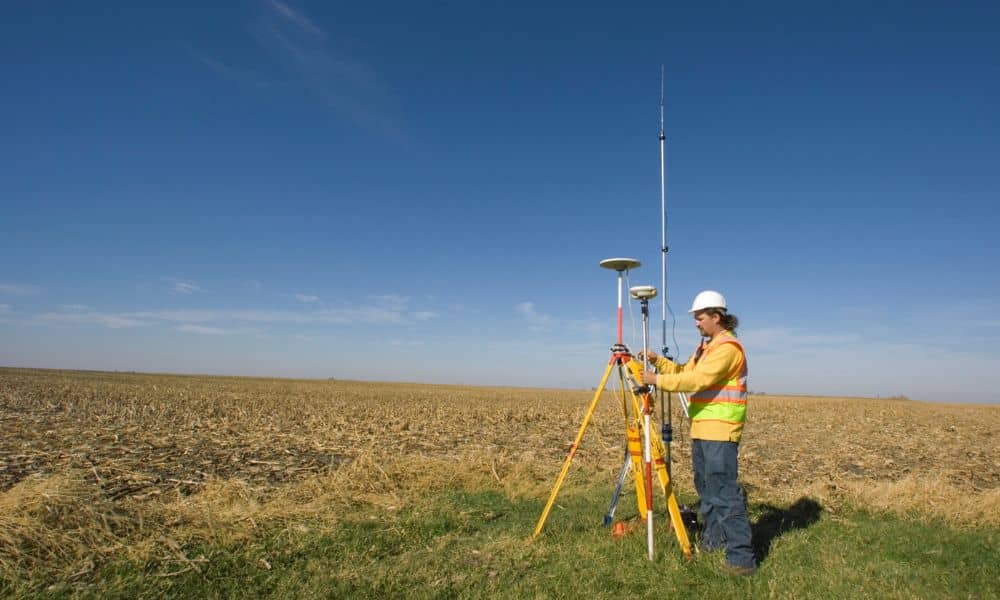
Today, land surveying uses satellite positioning in many types of projects. Survey crews use GNSS and GPS tools to locate points, set control, map terrain, and stake construction layouts. Because of that, projects move faster than they did years ago.
For example, crews can now cover large sites quickly. They can tie property data to coordinate systems. They can also connect surveys to county and state mapping grids.
Even so, good land surveying never depends on one tool alone. Skilled crews still verify points, check distances, and confirm field evidence. In other words, GPS supports the work — it does not replace survey judgment.
That distinction becomes very important during solar events.
What High Solar Activity Really Means
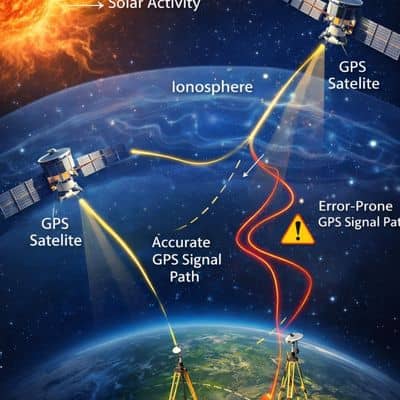
The sun does more than give light and heat. It also sends out energy bursts and charged particles. During solar flares and geomagnetic storms, that energy reaches Earth and disturbs the upper atmosphere.
Unfortunately, GPS signals must travel through that same layer.
When solar activity rises, the atmosphere becomes unstable for radio signals. Consequently, satellite signals can slow down or bend slightly before they reach survey receivers. Even a tiny delay can shift a measured position.
Think of it like looking at a coin at the bottom of a swimming pool. When the water moves, the coin appears to shift. Likewise, when the atmosphere gets “wavy,” the signal path changes.
So the receiver still works — but the path becomes less clean.
How Signal Disturbance Shows Up in the Field
During high solar activity, survey crews may notice odd behavior in their equipment. Notably, these signs do not look dramatic. Instead, they show up as small warning flags.
For instance, crews may see longer fix times when locking onto satellites. They may also see position values jump slightly between repeat shots. In some cases, quality indicators drop below normal levels.
Now, a phone GPS user might ignore that drift. However, land surveying cannot ignore it. Boundary work, building layout, and elevation control all require tight tolerances. Therefore, even small shifts matter.
Because of that, trained crews slow down and verify more often when signals act unstable.
Why This Matters to Property Owners and Builders
At first glance, solar activity sounds like a science topic, not a property topic. Still, it connects directly to real projects.
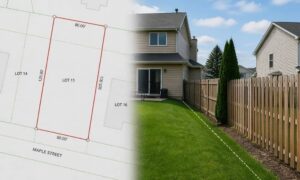
For example, imagine a contractor places foundation corners based on weak positioning data. Later, checks show a shift. That creates delay and added cost. Or picture a fence installed close to a boundary without strong verification. That can lead to disputes.
Similarly, grading and drainage elevations depend on accurate control. Small vertical errors can affect water flow and compliance.
So the risk does not come from the sun alone. Instead, the risk appears when someone trusts raw GPS numbers without a proper survey process.
That is exactly why professional land surveying includes redundancy.
How Professional Land Surveying Manages the Risk
Strong land surveying practice never trusts a single reading. Instead, crews build layers of verification into their work.
First, they tie into known control points and monuments. Next, they run repeat observations from different positions. Then, they compare results and check for consistency. If numbers disagree, they investigate.
In addition, crews switch methods when needed. They may use total stations, levels, and closed traverses to confirm positions. They also run check shots at the end of a session to confirm nothing drifted.
Because of that approach, temporary signal issues rarely damage final survey accuracy.
From a client point of view, extra checks may look like “slower work.” In reality, that extra time protects the project.
What Clients May Notice on Site During Solar Events
During high solar periods, you might notice crews spend more time verifying points. You may see them re-shoot control or pause before final layout. You might also see more cross-checks between instruments.
That is not wasted effort.
Instead, it shows discipline. It shows the crew refusing to guess. Most importantly, it shows they protect your outcome, not just their schedule.
Meanwhile, low-cost or DIY measurement approaches often skip those checks. As a result, they carry higher risk when signal conditions change.
Why Process Matters More Than Technology
Technology improves every year. Receivers get better. Software gets smarter. Networks grow stronger. Even so, no technology removes environmental limits completely.
Therefore, land surveying stays reliable because of process, not gadgets.
Survey standards require evidence, math checks, and field validation. Crews confirm corners with records and physical proof, not just coordinates. They adjust when conditions change. They document their work.
Because of that, professional land surveying delivers dependable results even during high solar activity.
The Bottom Line for Property Owners
Solar storms and space weather will continue. GPS will remain powerful but imperfect. However, good land surveying already accounts for that reality.
So if you plan a boundary survey, construction layout, or site project, choose professionals who verify their data. Ask how they check control. Ask how they confirm accuracy. Those questions matter more than brand names on equipment.
In the end, accuracy comes from method and discipline. Technology helps — but trained land surveying practice protects your property, your build, and your investment.