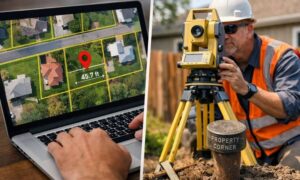
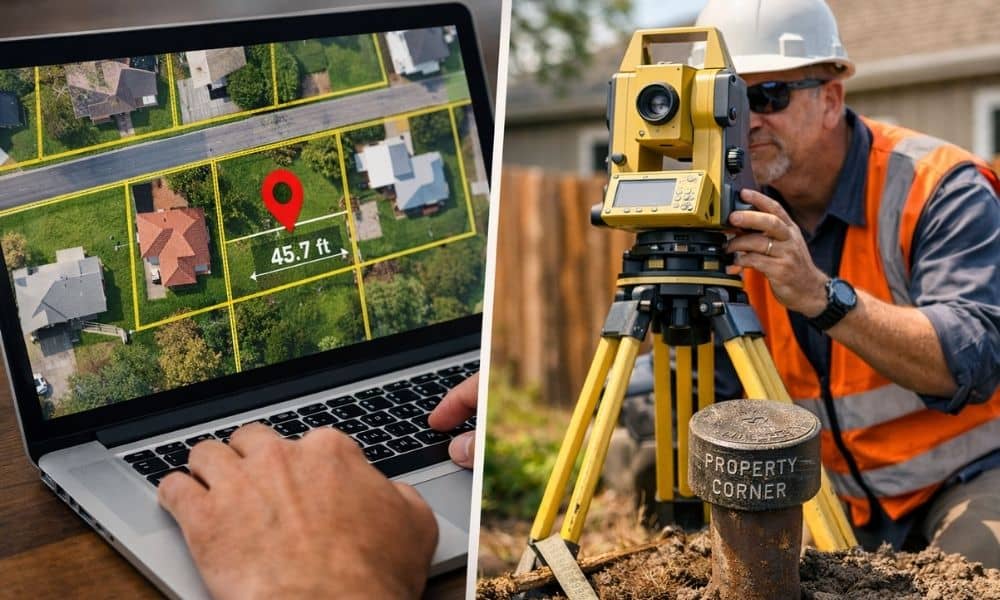
In the past few weeks, viral maps have spread across social media showing “exact locations” of events around the country. People zoom in, drop pins, draw lines, and share screenshots as proof. At first glance, those maps look official. They feel precise. However, precision on a screen does not equal legal accuracy on the ground. That distinction matters in Minneapolis. More homeowners now rely on parcel viewers, satellite imagery, and property apps to answer serious questions. They check where their fence should go. They measure how far an addition might extend. They even settle arguments with neighbors using a screenshot. Yet none of those tools replace a cadastral surveyor.
In fact, the more people trust crowdsourced maps, the more important true boundary expertise becomes.
Why Online Maps Feel So Convincing
Modern mapping tools look incredibly detailed. You can zoom in and see patios, decks, and driveways. Parcel lines appear sharp and clean. Measurement tools calculate distances instantly. Because of that, it feels like you hold professional-grade data in your hand.
However, most county parcel maps come with disclaimers. They serve as general reference tools. They do not represent surveyed boundary lines. Even a small shift in imagery alignment can move a visible line by a foot or more.
That might not sound like much. Yet in Minneapolis neighborhoods with narrow lots and tight setbacks, one foot can mean the difference between compliance and violation.
So while crowdsourced maps provide convenience, they also create a false sense of certainty.
Minneapolis Adds Its Own Layer of Complexity
Minneapolis contains older plats, historic subdivisions, alley-loaded lots, and redevelopment zones. Many homes in South Minneapolis and Northeast sit close together. Driveways often run near side lot lines. Garages back up to alleys where right-of-way lines create confusion.
In winter, snow can hide property monuments. In summer, landscaping and fences may sit slightly off true corners. Meanwhile, online parcel lines often overlay these features imperfectly.
As a result, homeowners assume what they see matches legal reality. Unfortunately, assumptions cause trouble.
A cadastral surveyor understands how those historic plats interact with current property law. They do not rely on what “looks right.” Instead, they reconstruct boundaries based on recorded documents and physical evidence.
What a Cadastral Surveyor Actually Brings to the Table
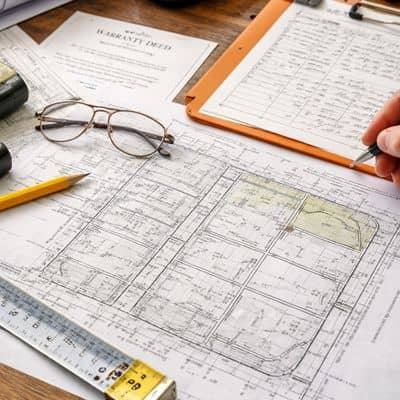
A cadastral surveyor focuses on legal property boundaries. That work starts with research. They study recorded plats, deeds, easements, and prior surveys. Then they evaluate how the land originally got divided and how later changes may affect it.
After that, they head into the field. They search for corner monuments, measure with survey-grade instruments, and verify positions against known control points. Finally, they analyze all evidence and determine the correct boundary location.
That process blends engineering precision with legal interpretation. It requires judgment and experience. Most importantly, it produces defensible results.
When a dispute arises or a permit requires proof, that documented boundary carries weight. A screenshot does not.
The Real Cost of Trusting a Digital Line
Imagine you plan to install a new fence. You check the county parcel viewer and see a clean line along your yard. It appears to match your existing fence. So you build right on it.
Months later, your neighbor hires a survey before selling their home. The survey shows your fence crosses 18 inches into their lot. Now you face removal costs, repair expenses, and a tense relationship next door.
Or consider adding a garage. You measure setbacks using an online tool and feel confident. However, when you apply for a permit, the city requests verification of property lines. Without a survey, your project stalls.
These situations happen more often than people admit. Crowdsourced maps rarely cause problems immediately. Instead, they create quiet errors that surface later — usually when stakes rise.
Crowdsourced Maps Show Location. They Do Not Define Ownership.
Social media amplifies information quickly. If someone posts a location pin, others accept it as fact. In everyday situations, that may not matter much.
However, property ownership operates under a different standard. Legal boundaries come from recorded documents and measured evidence. They tie back to established monuments and survey principles. A cadastral surveyor interprets those records and confirms their position on the ground.
In other words, while a map pin shows where something appears to be, a cadastral surveyor determines what the law recognizes.
That difference protects homeowners.
Why This Matters Even More Today
Minneapolis continues to see infill development, lot splits, renovations, and ADUs. As density increases, tolerance for error decreases. A driveway extension that worked decades ago may now violate updated codes. A shed that seemed harmless might cross a boundary.
At the same time, technology makes it easy to feel self-sufficient. With one click, anyone can measure property dimensions online. Yet confidence does not equal correctness.
Because crowdsourced tools continue to improve visually, the gap between appearance and legal certainty grows harder to see. That makes professional boundary verification more important, not less.
When It Makes Sense to Call a Cadastral Surveyor
Not every project requires a survey. However, when construction, property transfers, or disputes enter the picture, clarity becomes critical.
If you plan to build near a lot line, combine parcels, resolve a neighbor disagreement, or purchase property with unclear boundaries, bringing in a cadastral surveyor early often saves money and stress later.
Rather than reacting to a problem, you prevent it.
A Map Pin Is Not a Property Line
Online maps offer speed and convenience. They help people explore neighborhoods and understand general property layout. Yet they stop short of legal certainty.
In Minneapolis, where property lines affect permits, value, and neighbor relationships, guessing carries risk. A cadastral surveyor provides something digital tools cannot: verified, legally defensible boundary information.
So before you rely on a screenshot or draw a line on an app, pause.
Technology can guide you. However, when accuracy matters, a cadastral surveyor protects you.